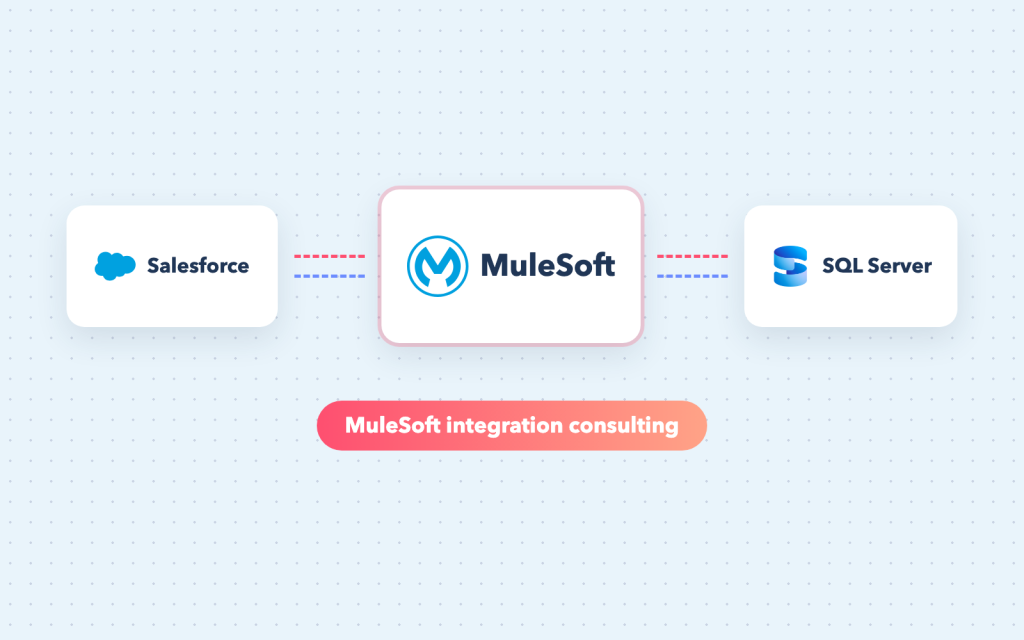



MuleSoft Anypoint Platform is built for organisations that want reusable APIs rather than one-off point-to-point links. Done well, each new project gets faster; done badly, it becomes expensive spaghetti. As a MuleSoft integration consultant I focus on clear API design and maintainable Mule applications.
What I do as a MuleSoft integration consultant
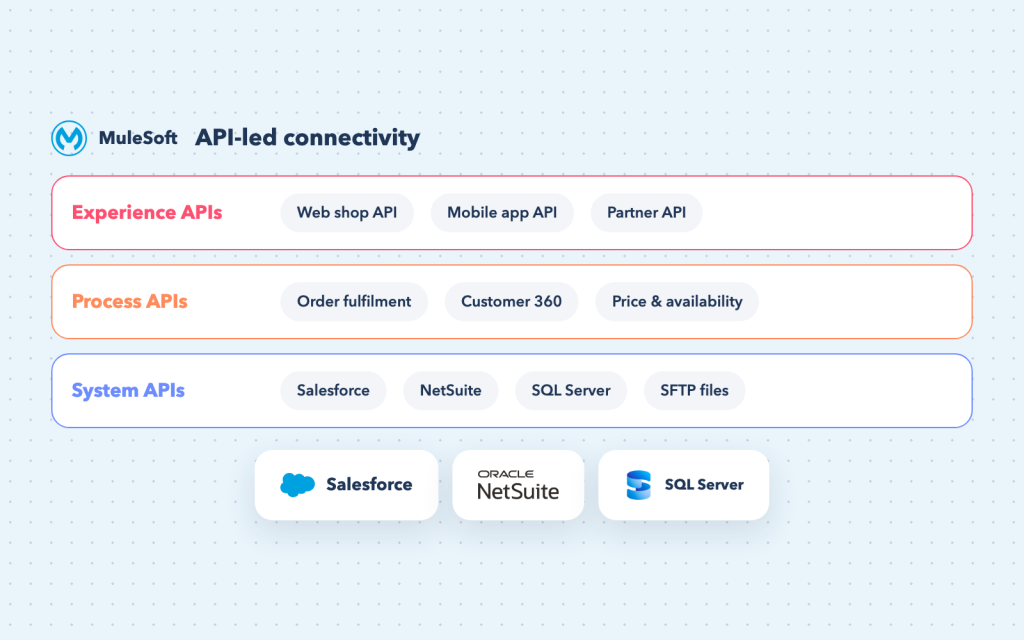
- API-led design: system, process and experience APIs
- RAML / OAS API specifications and API Manager policies
- Mule 4 applications, connectors and DataWeave transformations
- Error handling, logging, monitoring and alerting
- Salesforce, ERP, database and file integrations on Anypoint
- Review of existing Mule applications and deployment pipelines
Typical integrations
- Salesforce to ERP (NetSuite, SAP and others) order and customer sync
- A customer or product system API reused by web, mobile and partner channels
- Legacy SOAP or database systems exposed as modern REST APIs
- Event-driven flows using queues for high-volume updates
- Batch file and SFTP exchanges with partners
When MuleSoft is the right choice
MuleSoft fits larger organisations that will build many integrations over time, need governed APIs across teams and often run Salesforce at the centre.
For a small number of flows, the licence and engineering cost may be hard to justify — a lighter iPaaS can deliver the same outcome for less.
Working with teams in the USA, UK and India
I work remotely with companies across the United States — including New York, New Jersey, California, Virginia and Charlotte — as well as London and the rest of the United Kingdom, and India. Calls are planned around your working hours, progress is shared in writing, and you get access to everything that is built.
- MuleSoft integration consultant in the USA — New York, New Jersey, California, Virginia and Charlotte
- MuleSoft integration consultant in the UK — London and across the UK
- MuleSoft integration consultant in India — teams across India
Frequently asked questions
What is API-led connectivity?
Splitting integrations into layers: system APIs that unlock each back-end system, process APIs that hold business logic, and experience APIs shaped for each channel. New projects reuse the lower layers instead of starting from scratch.
Can you work alongside our in-house MuleSoft team?
Yes — on specific APIs, reviews, or by taking on a backlog while following your standards and pipelines.
Can you compare MuleSoft with Boomi for us?
Yes. I can lay out cost, skills, connectors and fit for your landscape — see also Boomi integration consulting.